"Do you print on eco-friendly paper?" It's one of the questions we get asked most often — and as environmental awareness grows across Hong Kong, more and more clients are asking about it. Yet most people aren't quite sure what eco-friendly paper actually is, which can turn a simple print order into a research project. So here's the plain-English version.
"Eco-friendly paper", true to its name, is paper that doesn't have a big impact on the natural environment. Broadly, it meets three conditions:
- The raw material is wood — because wood can be replanted again and again.
- The paper can be recovered and recycled into new paper, cutting down on waste.
- It's biodegradable, so it won't pollute the environment.
By that definition, plain uncoated paper already qualifies — so uncoated stock counts as eco-friendly paper too. But if trees are only felled and never replanted, that isn't sustainable at all; in fact it does real damage to the natural environment. That's why the whole forestry ecosystem needs an organisation to keep watch over it — and the best-known one is FSC.
About FSC
The Forest Stewardship Council — the FSC — is an independent, non-governmental, non-profit organisation set up to promote sustainable forestry and protect forest ecosystems. Only wood products (paper included) that come from the "well-managed forests" they certify carry the FSC mark — and that's what we mean by FSC eco-friendly paper.
What FSC is for
FSC certification guarantees that the wood and wood-based material in a product doesn't come from recklessly or illegally logged forests, but from forests the FSC has certified. Think of the FSC as the gatekeeper of the forestry world: through its platform, you can trace exactly which forest a piece of wood came from.
Its mission pushes in three directions — protecting the environment, creating social benefit, and building a viable economy:
- Environmental protection: making sure that harvesting trees still preserves the forest's biodiversity, productivity and natural ecology.
- Social benefit: helping local communities generate long-term employment, and involving local people in managing and planning sustainable forests.
- A viable economy: using structured systems and management to turn a profit — without sacrificing forest resources, natural ecology or the community.
It does all this by setting an international standard and a set of forest-management principles that deliver eco-friendly, sustainable, ecology-protecting forestry.
How does FSC manage it?
The FSC issues two kinds of certification: Forest Management (FM) and Chain of Custody (CoC) — the first held by forest owners, the second by the businesses that use the timber. Both are audited by an independent, FSC-accredited third-party certification body, which shows just how seriously the FSC takes certification.
The FSC tree-label categories
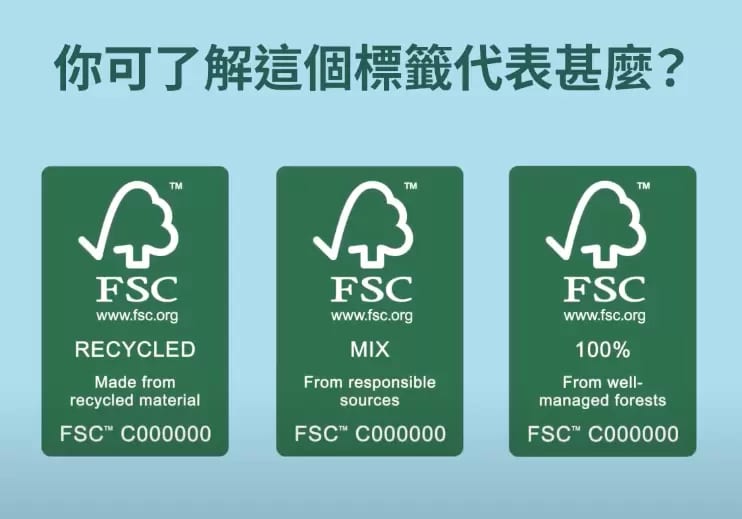
As the video shows, the FSC tree label mainly comes in three forms: FSC Recycled, FSC Mix and FSC 100%.
- FSC 100%: every bit of the wood material in the product comes from FSC-verified forests.
- FSC Recycled: the product is made from recycled material — though that recycled material doesn't necessarily originate from FSC-certified forests.
- FSC Mix: the product blends different sources, including FSC timber, recycled material, or other "controlled wood". Controlled wood isn't held to quite the same strict standard as FSC-verified forest land, but under the relevant rules it still avoids unacceptable sources — illegal logging; harvesting that violates traditional or human rights; wood from high-conservation-value forests; timber from land converted to plantation or non-forest use; and wood from genetically modified species.
What's special about FSC paper for printing?
Looking at the finished piece, the average reader won't notice an obvious difference. But because FSC raw material is so tightly controlled, the paper tends to be higher quality — and FSC-certified eco paper generally prints well. That said, a lot still depends on how the mill and the printer work, because different papers call for different printing methods, and that comes down to the press operator's experience.
Want to dig deeper into the FSC? Head over to fsc.org.
Eco-friendly paper = recycled paper?

With all of that in mind, the characteristics of eco-friendly paper are clear. Recycled paper is something else again: it's made by collecting waste paper, processing it, and turning it back into pulp that stands in for the virgin wood pulp usually used — and any paper made from that pulp can be called "recycled paper". Recycled paper is at least 80% recovered waste paper, so the production process is expensive, which is why good recycled paper tends to carry a higher price.
The whole point of recycled paper is keeping resources in circulation. But some unscrupulous suppliers, wanting to trade on the "recycled" name, pump large amounts of chemicals into the process to lift the quality of their "recycled" stock. Far from being green, that actually damages the environment. So before you use it, take the time to understand where it comes from and how it was made — otherwise you go from protecting the environment to harming it.
Being green matters — being green-minded matters more
Sustainability is clearly the direction of travel. But are we genuinely committed to it, or just leaning on the label? Going green costs more than usual — recovering paper, sorting it, every step adds cost (which is exactly why eco paper is pricier). If we print on eco-friendly paper but still use paper carelessly, the gesture doesn't really count for much.
Using eco-friendly paper is a good start, of course. But sustainability has to be lived — so from what we say to what we do, let's all carry a bit of environmental awareness, and skip the eco-hypocrisy. If you're weighing up eco-friendly or FSC stock for a print job in Hong Kong or Macau, WhatsApp us at +852 3001 5678 (English is fine) and we'll help you pick the right paper.