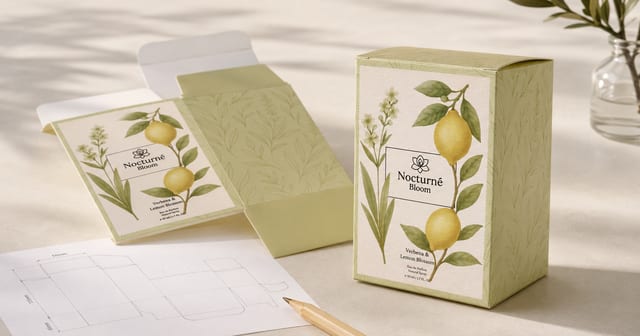
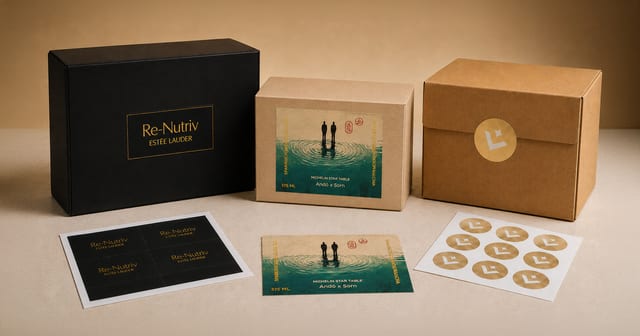
The same sticker can behave very differently on a paper box, a plastic bottle and a glass jar. On a box it has to sit well with the paper feel; on a bottle you have to watch the curve and the water resistance; on a clear glass jar a transparent background can leave your text hard to read.
Here we use the three most common surfaces — paper boxes, plastic bottles and glass jars — as our examples, then extend the same thinking to kraft bags, takeaway bags and other packaging. Framing it by surface is far easier to judge than simply asking "what sticker materials are there?"
If you already have a photo of your packaging and a rough size, you can send it to the Printing Banana team on WhatsApp first, then sort out the order or quote details based on the real use case.
Sticker material: start with the surface, not the finish
The place a sticker most often goes wrong isn't the artwork — it's the surface. Paper boxes, plastic bottles, glass jars and plastic bags all look like they'll take a sticker, but their smoothness, curvature, grip and usage environment are all different.
Packaging surface | What it's usually like | What to think through |
|---|---|---|
Paper box / kraft bag | Surface may have a paper grain; common for handmade, food and gift packaging | Match the sticker style to the paper feel; don't size it so big that it smothers the packaging's texture |
Plastic bottle / plastic jar | Smoother surface, often curved, and handled frequently | Watch the sticker size, the curve, the edges and abrasion |
Glass jar / bottle | Smooth, see-through surface; common for food, aromatherapy and skincare | Decide whether you want a solid-colour label or to keep the glass's clarity |
Plastic bag / takeaway bag | Creases and stretches easily; usually short-lived in use | Keep the content simple; avoid putting all the fine print and key terms on a sticker on the bag |
Put simply: if the sticker goes on a flat paper box, the priority is usually the visual and brand feel; if it goes on a bottle body or round jar, take one more step and ask — will the sticker be too wide, will the edges lift, will it rub as people pick it up?
Common material directions for box, bottle and jar stickers
If you want a quick starting answer, use the guide below. It isn't a fixed spec sheet — it's here to narrow things down before you enquire.
Use case | Suggested direction | Why |
|---|---|---|
Paper boxes, kraft bags, gift packaging | Matte or gloss paper stickers, or a paper-feel option | Works with the natural paper feel without stealing the packaging's texture |
Plastic bottles and jars that get picked up | Waterproof stickers, frosted stickers | They're constantly exposed to hand moisture, friction and curved surfaces |
Glass jars, clear bottles | Clear stickers, or clear stickers with a white-ink layer | Balances the see-through look with text readability |
Chilled drinks, wet environments | Waterproof, moisture-resistant stickers | Reduces the effect of moisture on the edges and the look |
Takeaway bags, short-run event packaging | Basic label stickers, focused on clear, easy-to-read info | Keeps cost in check; the priority is clarity and quantity |
QR codes, barcodes, lots of fine print | A white-background sticker is usually safer than a clear one | Easier to read than a clear sticker, with lower scanning risk |
If you just want a simple rule of thumb: paper boxes are about matching style, plastic bottles are about water resistance and adhesion, and glass jars are a trade-off between clarity and readability; and if there are QR codes, barcodes or fine print, a white-background sticker is usually a safer bet than a clear one.
When it comes to the actual order or enquiry, still confirm against the product-page options, your packaging surface, the usage environment and the design content.
How do water, refrigeration and hand sweat affect your choice?
The same sticker can perform very differently in a dry indoor setting, inside a chiller, or on packaging that gets picked up constantly. Food packaging, drink bottles, skincare, aromatherapy, handmade candles and takeaway boxes can all run into moisture, grease, low temperatures, hand sweat or abrasion.
Use case | Possible issues | What to watch when choosing |
|---|---|---|
Box seals, indoor labels | A fairly stable environment, with little moisture or abrasion | You can put more weight on design, paper feel and cost control |
Short-run event giveaways | Short lifespan, usually in larger quantities | Focus on clear content, quantity and budget |
Drink bottles, plastic bottles, skincare packaging | Picked up often; may see hand sweat and friction | Watch the sticker edges, the adhesion and the abrasion resistance |
Chilled food and drinks | May involve condensation, low temperatures and humidity | Prioritise water resistance, moisture resistance and edge stability |
Takeaway boxes, food packaging | May meet grease, moisture or packaging that deforms | Keep content clear; keep the sticker away from spots that easily get wet or creased |
Semi-outdoor or damp spots | More humidity, temperature swings and everyday abrasion | State the environment up front when enquiring, so it isn't judged as ordinary indoor use |
This doesn't mean every sticker needs the most durable material. When budget is tight, spend it where it actually affects use. A sticker for a short-run event giveaway, for example, can prioritise clear design and quantity; a label for chilled drinks should prioritise moisture, adhesion, edges and surface abrasion.
Too much on the sticker? Handling size and QR codes
Many sticker designs start out trying to fit too much: logo, product name, flavour, ingredients, storage instructions, Instagram, QR code, barcode, origin and tagline, all crammed onto one sticker. The problem is that as soon as the sticker shrinks, the first things to break down are usually the fine print and the QR code.
It helps to split sticker content into three layers:
Seen at a glance: brand name, product name, flavour or series name.
Read up close: volume, ingredients, storage tips, a short description.
Can live elsewhere: long backstory, full terms, too many social handles.
If the sticker is very small, don't force long text onto it. Instead, use one main label plus a small secondary label, or move the details onto a hang tag, product card, packaging insert or product page. That reads far better than compressing everything onto one tiny sticker.
Clear, white-background or kraft: which sticker should you choose?
Plenty of customers open with "are clear stickers classier, or are gloss stickers better?" It really depends on the packaging itself. A sticker doesn't exist on its own — it sits on a paper box, plastic bottle, glass jar, paper bag or takeaway packaging — so you have to weigh the background colour, the material, the clarity of the content and the overall brand feel together.
Sticker option | Good for | What to watch |
|---|---|---|
Clear stickers | Glass jars, clear boxes and minimalist packaging, where you want to keep the product's or packaging's see-through look | Light-coloured text, thin-line logos, fine print and barcodes may not read clearly — mind the contrast |
White-background stickers | When you need the product name, flavour, ingredients, QR code or barcode shown clearly | Visually safer, but watch that it doesn't cover too much of the packaging's own texture |
Kraft / paper-feel stickers | Handmade brands, food packaging, gift packaging, kraft boxes or paper bags | A natural, gentle look, but if the packaging itself is dark, be extra careful with text contrast |
Partial white / solid background | Glass jars or clear packaging that still has fine print, a logo or key info to show clearly | Balances clarity with readability; suits more refined packaging labels |
Frosted stickers | When you want a softer, understated, low-glare packaging look | Good for paper boxes, gift packaging and brand labels, but still judge it against the packaging's background colour |
What to prepare before you enquire about packaging stickers
To reach a sticker direction faster, get the following ready before you enquire. None of it has to be exact, but the clearer it is, the easier it is to judge size, material direction and design risk.
Information | Example |
|---|---|
Packaging surface | Paper box, plastic bottle, glass jar, plastic bag, kraft bag |
Usage environment | Indoor, chilled, damp, takeaway, short-run event, semi-outdoor |
Sticker purpose | Brand logo, product label, seal sticker, ingredient label, QR code |
Rough size | Placed on the front, the bottle body, the box top, the seal or the side |
Design content | Logo, product name, flavour, barcode, QR code, short description |
Quantity and variants | How many of each, and how many flavours or series |
If you already have a product photo, include it. From the sticker artwork alone it's hard to tell whether it will actually be too big, too small, too busy or not clear enough once it's on the packaging.
FAQ
Are clear stickers always more premium?
Not necessarily. Clear stickers are great for keeping the packaging's background colour or a glass look, but if the content has lots of fine print, a light-coloured logo or a barcode, it may not read clearly. A white-background or solid-colour label is sometimes easier to read and a safer bet.
Can I put a QR code on a sticker?
Yes, but mind the size and the quiet zone around it. A QR code that's too small, too close to the edge, or wrapped around a curved bottle can all affect scanning. Before sending files, print or preview it close to actual size and test-scan it with your phone.
Do stickers on plastic bottles peel off easily?
It depends on the bottle's curvature, how smooth the surface is, whether it's chilled or wet, and whether the sticker is too wide. When you enquire, it's best to provide a photo of the bottle, a rough sticker size and the usage environment, so the direction is easier to judge.
Will a clear sticker be hard to read on a glass jar?
It can be, especially with light-coloured text, thin-line logos or content that's too small. Consider a white background, a partial solid background, or adjusting the text-colour contrast. Before designing, preview the sticker on the actual glass jar or a similar background.
Anything special for food or drink packaging stickers?
First consider whether it'll be chilled, get wet, or be picked up frequently, and confirm which information must be clearly legible — flavour, date, ingredients or storage tips. That content shouldn't be shrunk for the sake of the design.
Ready to print your packaging stickers?
To print packaging stickers, gather a few things first: a photo of the packaging, the sticker's purpose, a rough size, the usage environment, the design content and the expected quantity. These help you settle on the sticker material, size proportions and layout faster, and cut down on back-and-forth revisions later.
If you already have a draft design, you can send that over to Printing Banana too. Based on your packaging surface, usage scenario and content needs, we can help you decide whether to go with clear stickers, white-background stickers, a waterproof direction, or something better suited to paper boxes and gift packaging. We deliver across Hong Kong and Macau, and you're welcome to WhatsApp us at +852 3001 5678 — English is fine.