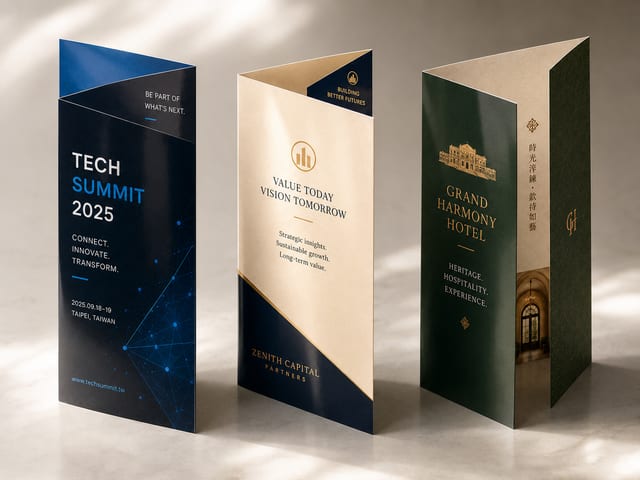
The same folded leaflet can feel completely different depending on whether you bi-fold, tri-fold, accordion-fold, gate-fold or cross-fold it. The real decision isn't "which fold looks the most eye-catching" — it's which one helps this particular content actually get read.
For a simple company profile, a service overview or a basic menu, a half-fold or a roll/tri-fold is usually enough. For a process, a map, an exhibition guide or a product range, an accordion fold, double parallel fold or cross fold makes it far easier to break the content into zones. Pick the wrong fold and you get the usual results: scrambled page order, text that's too small, a QR code landing on a crease, or a reader who opens it and has no idea where to look first.
The fastest way to decide: ask four things. How many panels does the content need? Do readers go through it in sequence, or open it up to find information? Is there a map, a flow or a timetable? And can the QR code, logo and key details stay clear of the fold lines?
Don't memorise fold names — start with content volume
The first step in choosing a fold isn't the shape — it's how much content you have. Too little content in an over-complex fold and the piece feels empty; too much information in a plain half-fold and the layout gets cramped. Set the number of panels first, then choose how it opens. That order is usually the safest.
| Content volume | Common direction | Suits | Next step |
|---|---|---|---|
| 4 panels | Half-fold / off-centre fold | Simple company profiles, service flyers, menus | Check the content isn't too sparse or too tight |
| 6 panels | Roll fold / tri-fold, accordion tri-fold, gate fold | Product intros, course info, brand promos | See the 6-panel options next |
| 8 panels | 4-panel accordion, double gate fold, double parallel fold, cross fold | Exhibition guides, event flows, info-rich intros | See the 8-panel options next |
| 10 panels or more | 5-panel accordion, cross tri-fold, pagoda / special Z-fold | High-information booklets, maps, product-range intros | Confirm paper thickness and folded size first |
The shortcut: pick a direction by use case
If you don't have a design yet, you can sort by use case first. It won't hand you the final spec, but it quickly rules out the folds that don't fit.
| What you're making | Look at first | Why |
|---|---|---|
| Simple company profile, menu, service flyer | Half-fold, roll fold / tri-fold | Intuitive to read, easy to grasp when handed out, low prepress risk |
| Flows, steps, product categories, exhibition routes | Accordion tri-fold, 4-panel accordion | Read panel by panel as it unfolds |
| Maps, wayfinding, large images, event guides | Cross fold, 4-panel accordion | Easier to take in the full picture once it's open |
| Invitations, brand intros, themed events | Gate fold, double gate fold | Opens with a sense of reveal — good for a hero visual |
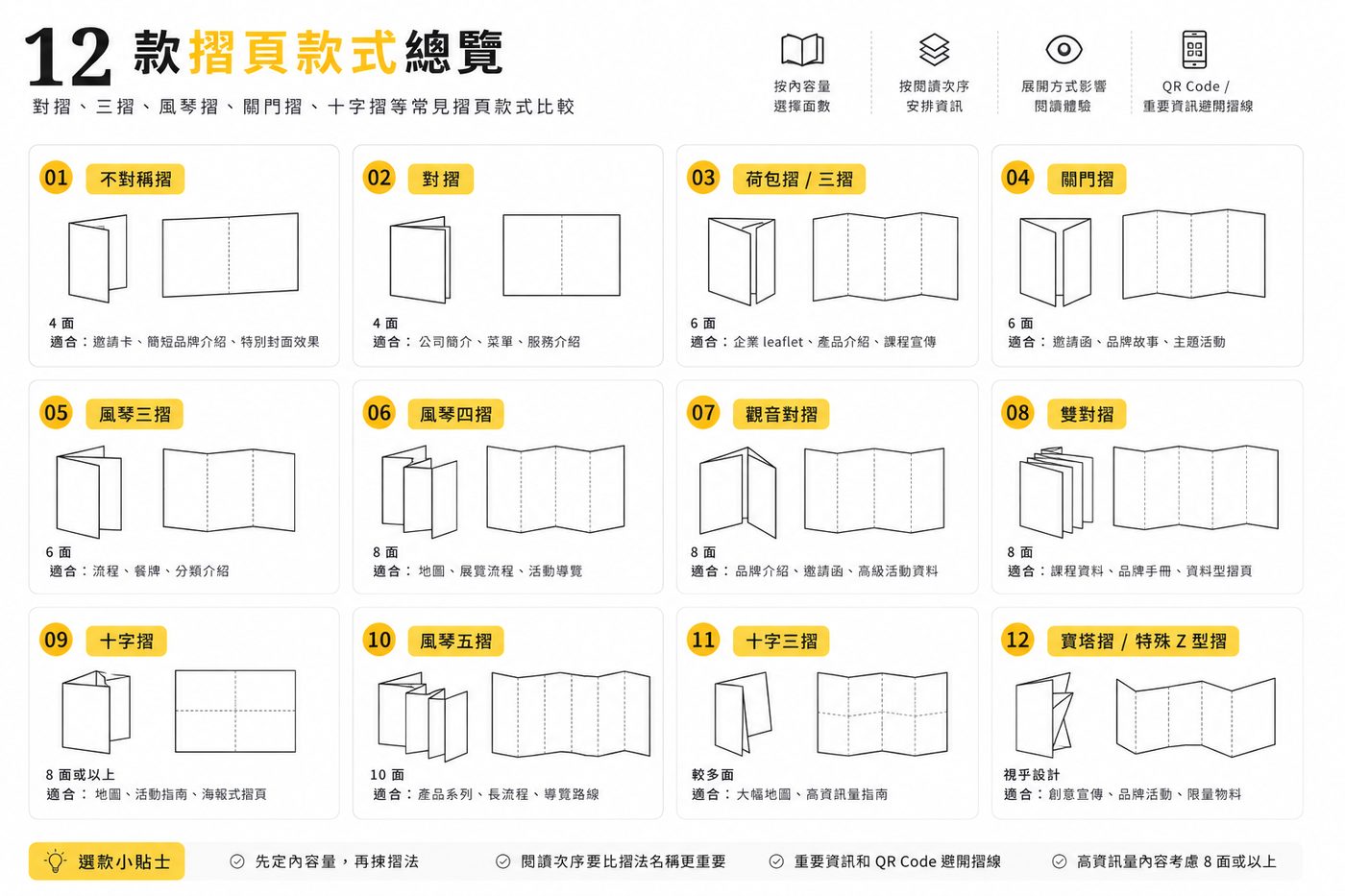
A quick comparison of common leaflet folds
| Fold | Panels when open | Best for | Watch out for |
|---|---|---|---|
| Half-fold (bi-fold) | 4 panels | Company profiles, simple menus, service intros | Don't cram it as densely as a booklet |
| Off-centre fold | 4 panels | Invitation cards, short brand intros, special cover effects | The left and right panels differ in width — confirm the dimensions before designing |
| Roll fold / tri-fold | 6 panels | Corporate leaflets, product intros, course promos | Confirm the inner-panel width and the reading order |
| Accordion tri-fold (Z-fold) | 6 panels | Step-by-step flows, menus, category intros | Give each panel a clear job — don't fill them evenly |
| Gate fold | 6 panels | Invitations, brand stories, themed events | The centre visual and the two "door" panels have to work together |
| 4-panel accordion fold | 8 panels | Maps, exhibition flows, event wayfinding | Content order has to follow the unfolding direction |
| Double gate fold | 8 panels | Brand intros, invitations, premium event material | Don't pack the fold-in panels with tiny text |
| Double parallel fold | 8 panels | Course material, brand handbooks, information-heavy leaflets | Map out the cover, back and inner-page order first |
| Cross fold (French fold) | 8 panels or more | Maps, event guides, poster-style leaflets | Keep QR codes and fine print off the central cross crease |
| 5-panel accordion fold | 10 panels | Product ranges, long flows, tour routes | Thick stock may not lie flat once folded |
| Cross tri-fold | More panels | Large maps, high-density guides | Confirm the open size and the cross-fold positions first |
| Pagoda fold / special Z-fold | Depends on the design | Creative promos, brand events, limited-run pieces | Needs a mock-up — you can't judge it from a flat layout alone |
Reading order matters more than the fold's name
Plenty of clients say "I want a tri-fold" when what they actually want is six panels — or an accordion that opens panel by panel. The name can come later; the reading order has to be settled first.
An exhibition guide, for example, is usually read along the walking route, so an accordion fold feels more natural. A brand introduction that wants a sense of occasion suits a gate fold or double gate fold. And if you're simply splitting service, price and contact details into a few zones, a plain tri-fold is already very practical.
Before you design, fold a quick mock-up from a sheet of A4 and label it "cover", "first open panel", "main content", "QR code" and "back". Folding it once by hand surfaces most page-order problems instantly.
Keep QR codes, logos and fold lines apart
The most common prepress problem with folded leaflets is a QR code, logo, phone number, address or price sitting right on a fold line. Creases curve slightly and carry normal production tolerance, so important content shouldn't sit close to a fold.
If your content includes a QR code, place it in the middle of a flat panel with clear margins on every side, and test-scan it at close to its real printed size with a phone. Don't put a QR code on the crossing point of a cross fold, on the centre line of a gate fold, or right beside the crease of an accordion fold.
Special folds: confirm stock and production first
Folds like the 5-panel accordion, cross tri-fold, pagoda fold and off-centre fold are more memorable, but they also need more checking — paper thickness, crease positions, page order and whether the fold is even producible. Stock that's too thick, repeated folding, or unequal panel widths can all leave the finished piece not lying flat, or even cracking along a crease.
If you want a special fold, it helps to prepare the intended use, content volume, size, a reference image and the quantity first, then check whether it suits the stock and fold you have in mind.
3 common ways people pick the wrong fold
| Situation | Likely problem | Better approach |
|---|---|---|
| Choosing a special fold just because it looks unusual | Too little content — feels empty once it's opened | Let content volume set the panel count first, then decide whether you need a special open |
| Lots of information but sticking with a plain tri-fold | Text too small; QR codes and charts crowd the fold lines | Move up to 8 panels, or re-cut the content hierarchy |
| A map or flow, but no reading path drawn | The reader doesn't know which panel to read first | Make a paper mock-up marking the cover, first open panel and CTA |
Leaflet fold selection checklist
- Is your content 4, 6, 8 panels — or more?
- Will readers go through it in sequence, or open it up to hunt for information?
- Is there a map, flow, timetable or a lot of information?
- Does it need to open out like a poster or a wayfinding sheet?
- Do the QR codes, logo, prices and contact details clear the fold lines?
- Is the stock suitable for multiple folds?
- Do you already have an open-out layout and a folded mock-up?
FAQ
Is a more unusual fold always better?
No. A special fold can add memorability, but if the content is simple, a half-fold or a plain tri-fold reads more easily. Match the fold to your content volume, reading order and where the piece will be used.
What's the difference between a tri-fold and an accordion fold?
A tri-fold usually folds its panels inward on top of each other, while an accordion fold zig-zags in and out like a "Z". Both can make a 6-panel leaflet, but the reading rhythm is different.
Which fold suits a map or an event flow?
If the content should be read along a route or in time order, a 4-panel accordion, 5-panel accordion or cross fold is usually the easiest to follow. It still depends on the size, the content volume and how the piece is handed out.
Can I order a special fold straight away?
For special folds, supply a reference image, the dimensions, the quantity and the intended use first; confirm the fold, the stock and the production direction before you prepare the final artwork.
Ready to choose a leaflet fold?
Related reading and products
If you already know you want six panels, read What's the difference between tri-fold, accordion and roll folds?; if your content needs eight panels, see How to choose an 8-panel fold. Before you send artwork, run through the folded-leaflet artwork checklist to confirm your fold lines, page order and QR-code placement.
On the product side, start with our leaflet folding style guide, then route to either a 2-crease (6-panel) or a 3-crease (8-panel) folded leaflet by how much content you have. We deliver across Hong Kong and Macau — and when you enquire, sharing the use, content volume, size, quantity, a reference image, your QR-code position and a rough page-order sketch makes it far easier to point you to the right fold than just asking "can you print folded leaflets?". Prefer to talk it through? WhatsApp us at +852 3001 5678 (English is fine).