There are three printing methods you'll run into again and again in the trade: gang-run printing, dedicated-plate printing and digital printing. The arrival of gang-run printing dramatically cut production costs. Before it existed, small-batch printing was expensive, because essentially everything was dedicated-plate work — and print prices only got cheap once you hit a certain volume. A printer's cost includes the fixed expense of pressroom make-ready and running the machine, so the more you print, the more finely that fixed cost is spread. Print used to be a heavy expense for small and medium businesses, who ended up stockpiling piles of unused or out-of-date collateral. Gang-run and digital printing are exactly what solved the small-batch problem. Here's a closer look at how the three differ.
What is gang-run printing
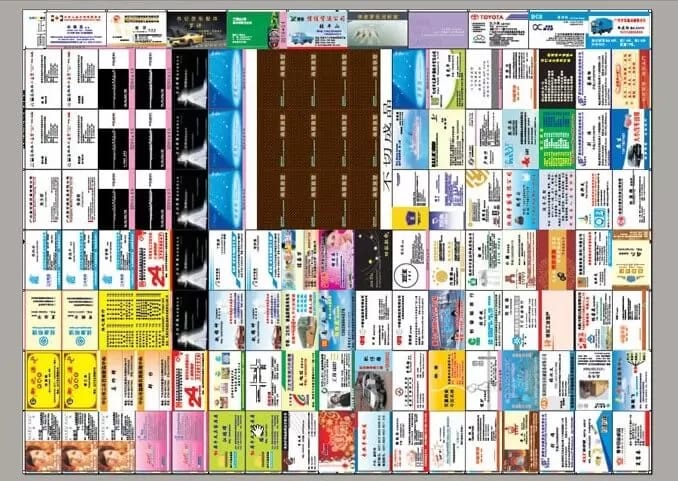
Gang-run printing (also called ganged or pooled-plate printing) combines jobs that share the same printing conditions onto one sheet (as shown above) — the same paper stock, the same weight, and the same number of ink colours. Today, gloss art paper, matte art paper and woodfree (book) paper are the most common gang-run stocks. Ganging up jobs uses the full effective print area of the press and spreads the fixed cost efficiently, bringing the quote anywhere from 30% to 200% lower than a dedicated-plate job. Besides the lower cost, gang-run also speeds up production, since you no longer have to wait for one plate run to finish before the next begins. And because different jobs can be ganged together, the minimum quantity is far lower than dedicated-plate printing — at some of the larger printers, you can print from as few as 100 sheets.
Because ganging is really about pooling resources — you could call it a shared press — gang-run only works for high-demand stocks such as gloss art, matte art and woodfree paper. For a special stock like xuan (rice) paper, gang-run simply isn't an option.
The great advantage of gang-run is that many pieces with different content can be printed in a single run — small-batch printing included — which suits SMEs perfectly. It also brings more variety and more variation to your marketing pieces, and lets you print personalised items such as cards with different names, postcards and the like. On top of that, turnaround is fast. SMEs struggle to use up large print runs, so gang-run printing has fuelled SME demand for printed collateral.
The biggest drawback of gang-run is a 10–20% colour variance in the finished pieces. Because a single plate carries many different colours, the ink on neighbouring jobs affects yours — if your card is pale yellow and the card beside it is black, your pale yellow can come out darker. What's more, the content of every gang-run sheet is different, so the degree of interference varies too, which means the colour will differ on every reprint.
What is dedicated-plate printing
Dedicated-plate printing means the entire plate carries only your own job — the way everything was printed before gang-run came along. You can print exactly to your own requirements, whether that means a spot colour, a special material or a non-standard spec. Dedicated-plate work also lets you request a proofing service: because nothing else shares the plate, a proof can help tune your piece into its ideal state. For a company with a fixed brand colour, dedicated-plate printing is essential to reproduce that colour faithfully — gang-run would drift too far.
The biggest problem with dedicated-plate printing is the higher cost: because the plate is made just for you, you carry the plate fee yourself. To save on that fee, you increase the print quantity — that lowers the per-plate cost, and the more you print, the cheaper it naturally gets. For a small run, dedicated-plate printing costs anywhere from 50% to 200% of the gang-run price; but at tens of thousands of pieces, the difference between the two is slight.
What is digital printing
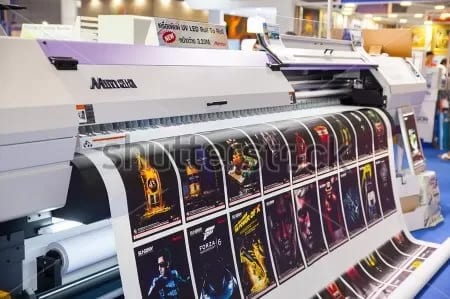
Digital printing prints your computer file straight onto paper. Unlike traditional offset printing, it skips plate-making, plate exposure and the other pre-press steps — a big advantage for rush jobs, which can basically be printed within a few hours. Digital prints from a single sheet and is ready the moment it's done, so if you spot a problem you can fix it on the spot: highly flexible. Print 20 today, add another 100 tomorrow. You get high-quality printing with no minimum order. Built on the foundation of desktop printing, digital printing carries your artwork as an electronic file, sends it over the network to the digital press, and prints directly.
Simple, fast, flexible — with all these advantages and a wide range of uses, from large-format work to books and booklets, digital printing is an extremely important option for the speed-driven advertising industry.
For all its strengths, digital printing is still never as cheap as gang-run, because it's priced per single sheet: the price rises steadily no matter how much you print, whereas with gang-run the per-sheet price gets cheaper the more you print. So on common stocks, digital printing still can't replace gang-run. The inks and toners used in digital printing also differ from the offset inks used in gang-run, so the results look different too — gang-run colours come out more solid, while digital tends to look brighter but less substantial.