More and more Hong Kong parents are making their own teaching flashcards—sometimes with a little help from AI—turning the people, objects, places and everyday moments a child already knows into small cards you can flip through, point at and talk about together. Because the content comes straight from daily life, children take it in more easily; for parents, it's a way to turn your attention, observation and learning into a little toolkit that belongs to your own family.
But if you want flashcards that actually work, sort a few things out before you print: one idea per card, type that's big enough, images that read clearly, and a sorting system that's easy to pack away.
Drawing on our printing experience, this guide walks through what to watch for in the content, design, size, sorting and file prep for teaching flashcards. Whether you're a parent, an education centre, a teacher or a therapist, the same method makes your enquiry, quote and production run more smoothly.
Decide first: who is this set of cards for?
Before you open Canva or Illustrator, don't rush. The first step is to be clear about who will use the cards.
| User | Content focus | Design considerations |
|---|---|---|
| Parents, at home | Words, pictures, people and objects your child already knows | Big type and a simple layout, easy to read alongside your child |
| Education centre | Lesson themes, levelled content, reusable | Clear categories so teachers can hand sets over to one another |
| Parent-child activity | Tasks that are easy to grasp in a short time | Easy to hand out, collect back and group |
If the cards are just for home, make a small test batch first; if they're for an education centre or a workshop, think earlier about how many cards per set, how many sets, storage and reprints.
One learning point per card
The most common problem with flashcards is cramming too much onto a single card: the Chinese character, the English, the pinyin, an example sentence, a picture and the rules of a game, all at once. It looks thorough, but when a child actually uses it, they don't know where to look first.
A safer approach is to let each card handle one main learning point.
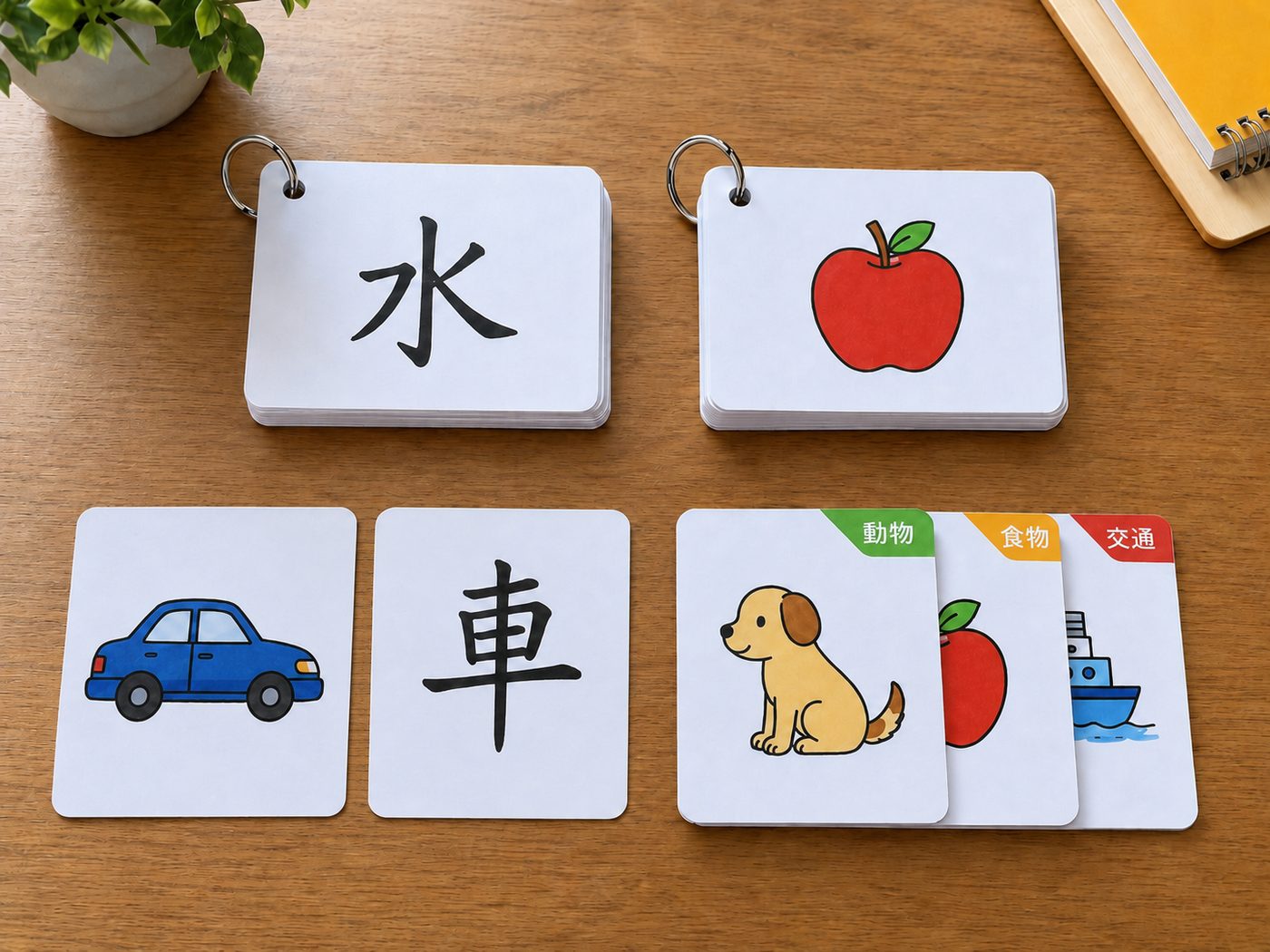
- Word cards: built around one large character or word.
- Picture cards: built around one clear image, with text as support.
- Matching cards: the image on one, the word on another, so they pair up in a game.
- Sorting cards: use colour, an icon or a corner mark to signal the group.
If you really do want to include how-to-play notes, make a separate instruction card instead—don't turn every card into a mini textbook.
Big type, simple images
A DIY flashcard doesn't need much in the way of design effects. For a child, clear usually beats fancy.
Which font?
Choose a typeface with clear strokes—not too thin, not too decorative. Chinese characters especially: watch the stroke density, because if a character is too small it's even harder to read once printed.
Before you send the file, shrink the design to roughly its real printed size and look at it from a short distance. If you have to concentrate hard to read it yourself, it won't be ideal for a child.
Which images?
An image should read at a glance, without a busy background. For "apple", show one clear apple—you don't need the tabletop, a plate, a hand and a pile of decorative extras all in the shot.
- Is the subject of the image clear?
- Is the background too busy?
- Is the image style consistent across the set?
- Does it stay sharp when scaled up to actual size?
Home use vs an education centre: what's the difference?
Flashcards for home use can hug a child's daily life more closely; flashcards for an education centre need to lean harder on consistency, sorting and durability.
| Situation | What works | What to avoid |
|---|---|---|
| Home use, by parents | Use familiar household objects, family members and everyday scenes | Making too many at once—printing in bulk before you've tested them |
| Education centre | Group by theme, level and lesson purpose | Every teacher on their own format, impossible to organise later |
| Handing out at events | Simplify the game; add numbers or colour coding | Too many cards, no storage—easy to lose after the activity |
If you run an education centre, start with the DIY-parent mindset for your first version: simple, clear, testable. Once you've confirmed the class really uses them, then look at printing more sets and building a fuller teaching kit.
Plan sorting and storage from the start
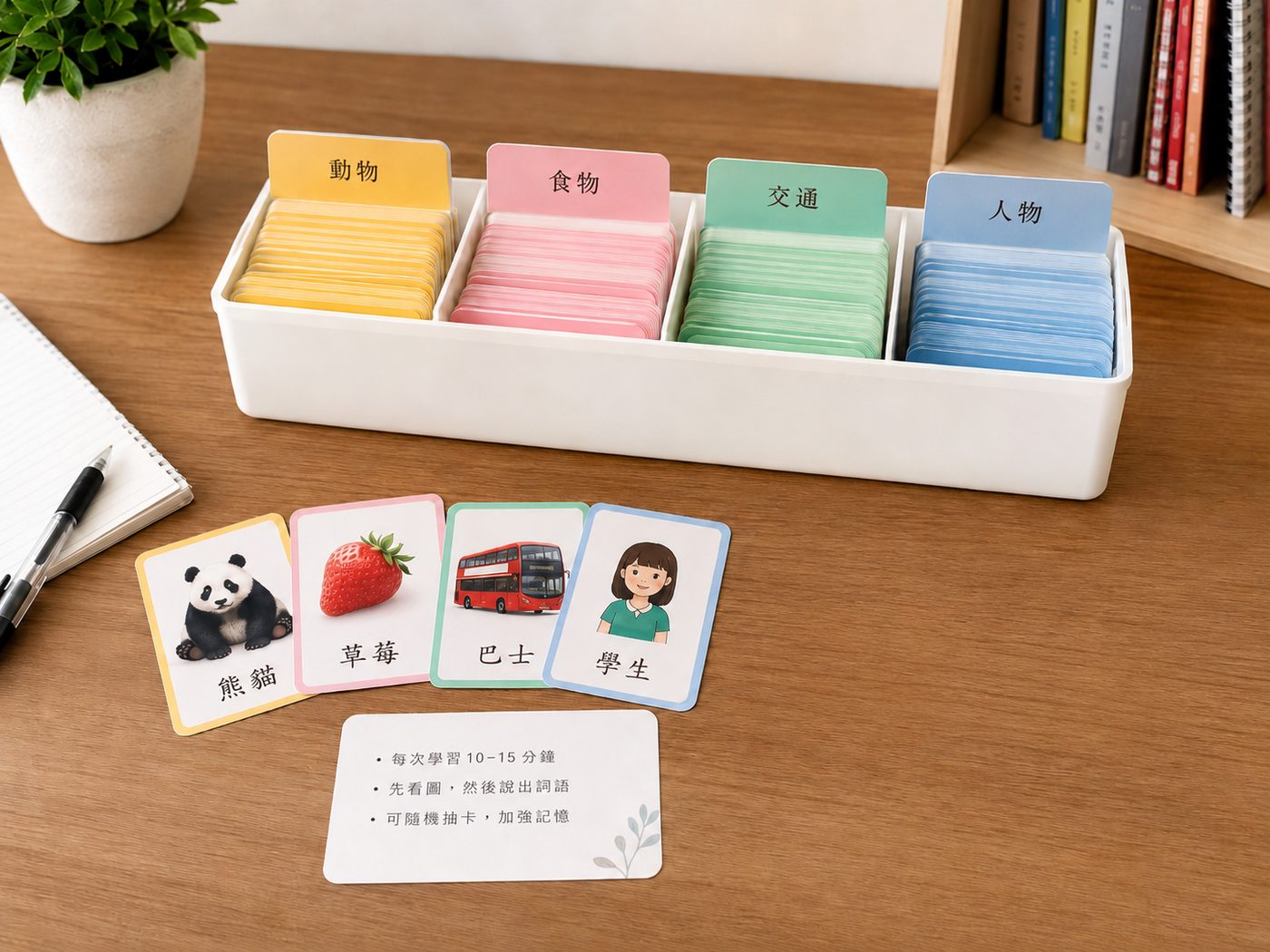
A set of 10 cards is no storage headache; but once you reach 30, 50 or 100, how you sort them directly shapes the experience.
Common ways to sort them:
- Group by colour—for example animals, food, transport.
- Group by number, so teachers can hand them out and collect them easily.
- Mark level or theme with a small corner icon.
- Add a short answer, English or a hint on the back.
Decide on storage early too. Do the cards need a pouch, a box, divider cards, elastic bands or an instruction card? All of that affects the size, the card count and how a quote is worked out.
What doesn't belong on every flashcard?
Whether a flashcard is easy to use often comes down not to how much you put on it, but to how willing you are to cut the extras.
- Long teaching instructions.
- Too many example sentences.
- A QR code that's too small.
- An over-complicated background image.
- Full game rules that only an adult can read.
That material can live on an instruction card, a booklet or an inside packaging page. The clearer each card is, the easier it is to stay focused when it's actually in use.
If the flashcards are for toddlers or young children, we suggest an adult uses them alongside the child, and that you weigh the size, rounded corners and storage against the child's age, how the cards are used and material safety.
What to prepare before you enquire about printing
Flashcards tend to be a fairly custom print job. If you want to ask about print options, it's better not to just ask "how much for one set"—pull together the following first.
| Detail | Example |
|---|---|
| Purpose | Home use, education-centre lessons, a parent-child workshop |
| Card content | Word, picture, matching, sorting, English vocabulary |
| Cards per set | 20, 50 or 100 per set |
| Number of sets | 1 test set, 10 sets, 50 sets or more |
| Printed sides | Single- or double-sided |
| Finishing & storage | Rounded corners, lamination, storage box, divider cards, instruction card |
If you already have a draft, you can share the images, text and expected size at the same time, so we can quickly judge whether it's suitable for printing.
FAQ
How many cards should a DIY flashcard set start with?
For home use, start with 10 to 20 cards to test whether your child is interested, whether the type is big enough and whether the images are easy to understand. Once the direction is confirmed, gradually add more themes and more cards.
Should flashcards be single- or double-sided?
Single-sided suits quick word or picture recognition; double-sided lets you put the word or picture on the front and the answer, English, pinyin, a number or a hint on the back. For an education centre, double-sided helps teachers organise and group them.
Can an education centre use the same method to prepare teaching cards?
Yes. An education centre just has a few more things to weigh than a parent: whether to print multiple sets, whether to split by level, whether storage is needed, whether different teachers can use them easily, and whether reprints will be needed later.
Do flashcards need rounded corners?
It depends on the use and the material. Rounded corners soften the sharp edges and make a card feel more finished in the hand; but whether you need them should be weighed together with size, the user's age, budget and production method.
Getting your DIY flashcards ready to print as a set?
Start by sorting out the purpose, the users' ages, how many cards per set, how many sets you need, single- or double-sided, and whether you want rounded corners, a storage box or an instruction card.
If you're not yet sure about size, material, card count or storage, WhatsApp Printing Banana at +852 3001 5678 (English is fine)—we have plenty of experience printing teaching materials, with delivery across Hong Kong and Macau. Share the purpose, a content sample and your expected quantity, and we'll help you work out the right print direction.