Getting the wording on a Chinese wedding invitation right matters more than most of us realise. These days plenty of people can't remember the format for an ordinary letter, let alone the one letter that might be the most important they ever send — and put the wrong title or phrase on it, and you can expect relatives to keep teasing you about it right through to next Lunar New Year.
There's a lot of fine detail to get right, and a Chinese-style invitation has more of it than most: the honorifics, the order of the names, the set phrases. This guide walks through the standard wording, section by section. If we've left anything out or a point needs more explanation, we'll fill it in.
How to word a Chinese-style wedding invitation
For the older generation especially, a wedding invitation is expected to follow the classic Chinese format, so it's worth understanding exactly what belongs on it. We'll start with the wording inside the invitation.
The basic layout
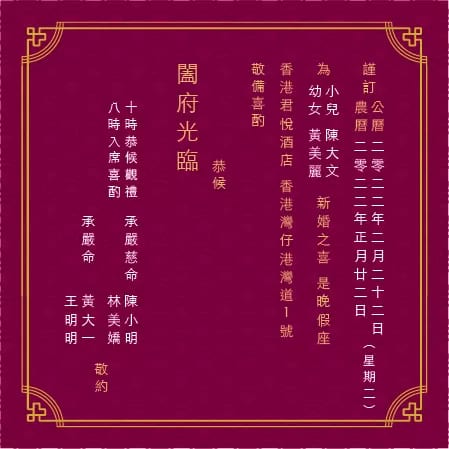
- The banquet date and time. Before the date you need an opening phrase; in Hong Kong and Macau this is usually 「謹訂於」(jǐn dìng yú, roughly "we respectfully set the date of…"). Write both the lunar and the Gregorian date clearly. The numbers are almost always written in the everyday Chinese numerals rather than the formal ones:
Everyday: 一、二、三、四、五、六、七、八、九、十
Formal: 壹、貳、叄、肆、伍、陸、柒、捌、玖、拾 - The couple's names. A Chinese invitation reads right to left, and by the "groom first, bride second" convention the groom's name sits on the right and the bride's on the left. You also mark each person's birth rank within their family, written as an honorific above the name. Use the table below:
| Groom's title (新郎) | Bride's title (新娘) |
|---|---|
| 長男 — eldest son 次男 — second son 三男 — third son 四男 — fourth son (and so on for later ranks) 幼男 — youngest son 小兒 — an only son (sisters are not counted) |
長女 — eldest daughter 次女 — second daughter 三女 — third daughter 四女 — fourth daughter (and so on) 幼女 — youngest daughter 小女 — an only daughter (brothers are not counted) |
For example, if the groom 陳大文 (Chan Tai-man) is his parents' only child and his partner is the youngest in her family, the titles read:
小兒 陳大文
幼女 黃美麗 (Wong Mei-lai)
To help it sink in, here's a quick quiz. 王大明 (Wong Tai-ming) has two older brothers and one younger sister, while his partner 李玉蘭 (Lei Yuk-lan) has one older brother and two younger brothers. What titles should they use? (Select the blank space to reveal the answer.)
三男 王大明
小女 李玉蘭
- The registration and banquet venue.
- The lead-in phrase can be 「於」 or 「在」 (both simply "at") or 「假座」(jiǎ zuò), the most formal option. Pair it with a time word — 是晚假座 ("that evening, held at…") or 是日假座於 ("that day, held at…").
- State whether the day is a 結婚典禮 (wedding ceremony) or a 訂婚典禮 (engagement ceremony).
- After the venue, name the catering with one of these set phrases:
- 敬備喜酌 — the usual choice: "we have respectfully prepared a generous banquet."
- 敬備薄酌 — more modest: "we have respectfully prepared a simple meal, a small token of our regard."
- 敬備茶點 — for a ceremony with no dinner: "we have respectfully prepared refreshments."
- Then invite your guests. A common pairing is one of 「恭請」/「敬請」/「敬希」/「恭候」/「台端」 followed by 「光臨」. Some write 「闔府光臨」("the whole household is welcome") to invite the entire family; plain 「光臨」 leaves it more open.
- Reception and seating times. For example, 六時恭候 (guests received at six) and 八時入席 (seated at eight).
- The sign-off (下款). Chinese correspondence takes the closing seriously, so this last line matters. An invitation is traditionally issued in the names of both sets of parents — as the old saying goes, 「父母之命、媒妁之言」, a marriage made "by the parents' command and the matchmaker's word." That means four elders' names appear at the foot. If the paternal grandparents are still living, add an honorific above the respective father's name: 承嚴慈命 when both the grandfather and grandmother are alive, 承嚴命 when only the grandfather is, and 承慈命 when only the grandmother is. Note that the maternal grandparents are not mentioned, as they belong to the 外家, the wife's "outside" family.
Wording for special situations
A morning ceremony with an evening banquet
謹訂於 [date] 為 [couple's names] 於 [ceremony venue] 舉行結婚典禮,是晚假座 [banquet venue] 敬備喜酌。
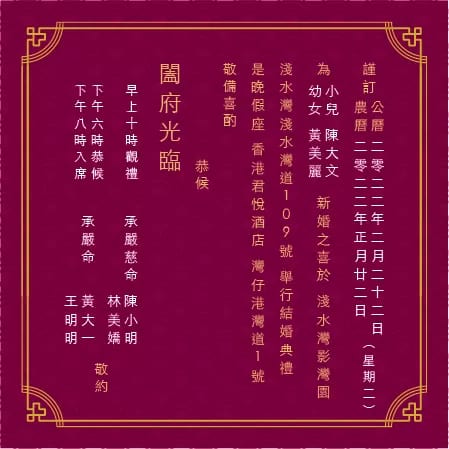
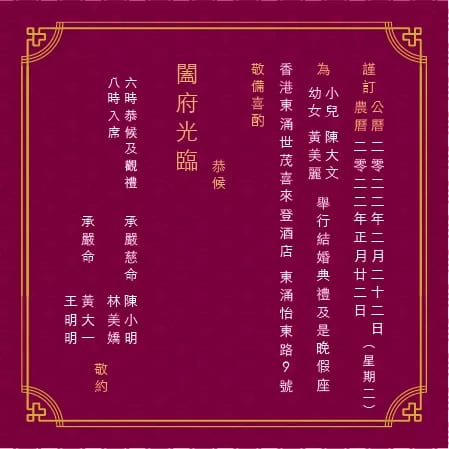
Ceremony and banquet in one place
Some couples hold the ceremony and the dinner at the same venue for their guests' convenience, with the ceremony scheduled just before the banquet begins.
Registered overseas, banquet back in Hong Kong
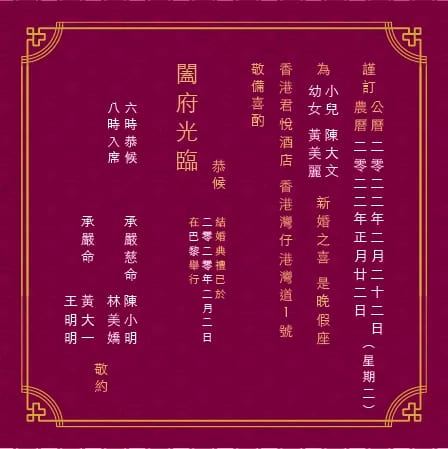
Add a note in the blank space between the body and the sign-off: 結婚典禮已於 [date] 在 [country/region] 舉行 ("the wedding ceremony was held on [date] in [country/region]").
Divorced parents
The mother's name does not take her husband's surname.
One parent has passed away
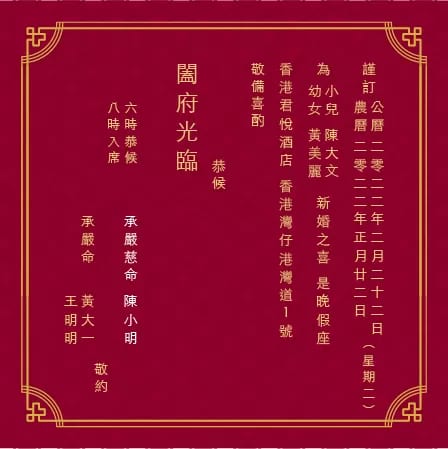
Simply omit the name of the parent who has passed away.
Both parents have passed away
The invitation can be issued in the name of an uncle or an elder brother, or in the couple's own names. In that case the opening changes to 「我倆謹訂於…」("we two respectfully set the date…"), and the sign-off becomes simply the groom's and bride's names.
Marrying into the bride's family (入贅)
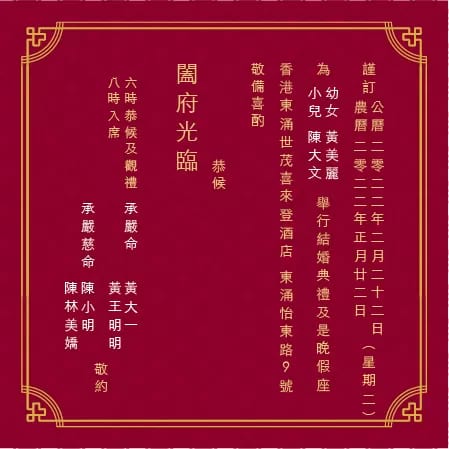
If the groom marries into the bride's family as a live-in son-in-law, the bride's name goes before the groom's — the reverse of the usual order — and the parents' names likewise put the bride's family first.
Complex, but full of meaning
A Chinese-style invitation asks more of you when it comes to the wording, but it also carries a great deal of traditional culture. If you're going to use it, following the conventions properly is the respectful thing to do.
There's plenty more to know about printing a wedding invitation, and we'll cover it in future articles. When you're ready to print, our traditional Chinese wedding invitations are made for exactly this, with delivery across Hong Kong and Macau. Not sure about a title or a set phrase? WhatsApp us at +852 3001 5678 — English is fine — and we'll help you get the wording right.