Book layout is the fussiest job in print — there are more small details to get right than in almost any other product. If you've never taken a book through production, it's hard to appreciate how much can go wrong. We've all read books since childhood, but actually manufacturing one is another matter entirely. This guide walks through the problems you're bound to run into when you print a book.
The most common book-layout mistakes
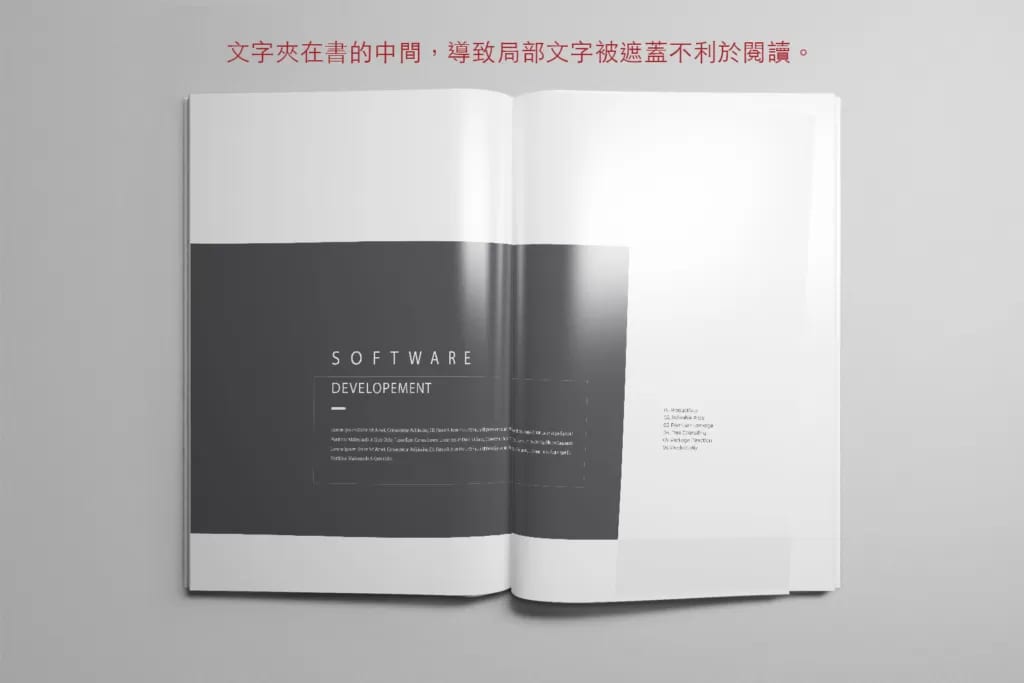
- Text running across the gutter. Keep body text out of the centre fold as much as you can — text sitting in the middle of a spread is hard to read. And apart from butterfly binding, no binding method can reveal text that falls right in the fold.
- Artwork or images with no bleed. Every print file needs bleed, yet it's the thing people overlook most often. Before you send a book to print, set a 3mm bleed and extend every edge-to-edge background colour or image all the way into it.
- Border designs. Plenty of designers love a border, but borders are unkind to print. When the trim lands with any real variance, the bound book ends up with uneven, mismatched frames.
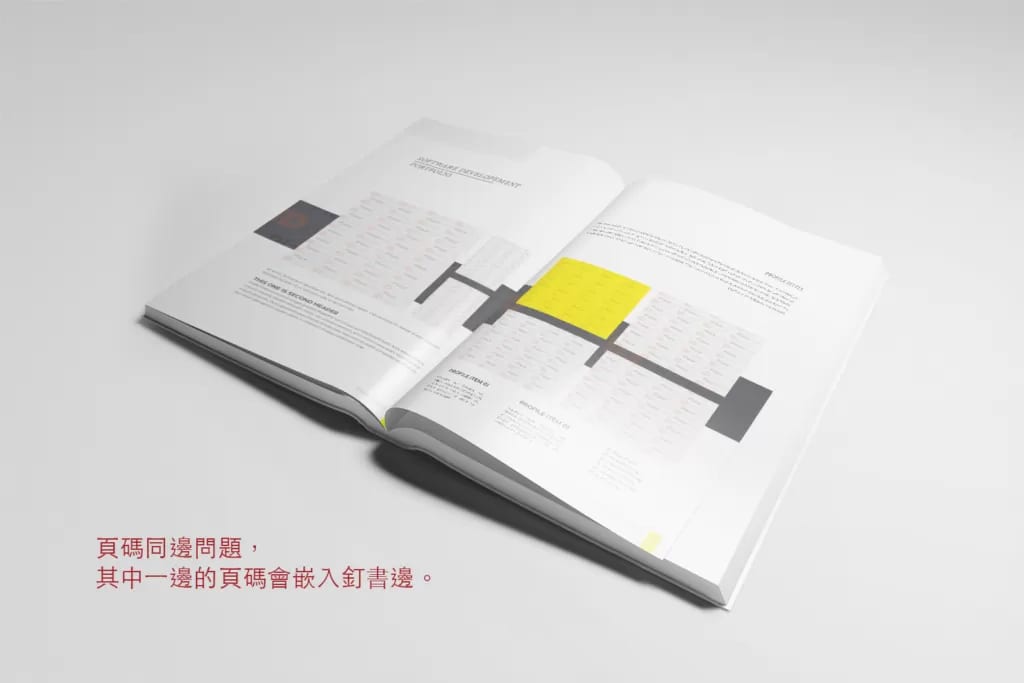
- Page numbers hugging the binding edge. Put the page number too close to the binding edge and it gets swallowed into the spine; even with a bit of clearance, the result is rarely ideal.
The double-page spread problem
A spread across two facing pages is probably every designer's favourite layout move — but not every binding method can actually pull it off. Each binding style handles the spine in its own way, and what works for one simply doesn't exist in another.
Butterfly binding is the most spread-friendly of all the methods. Each pair of facing pages is printed on a single sheet, then the sheets are mounted back-to-back and glued into a book — so you never have to worry about a spread breaking across the gutter.
Perfect-bound softcover books / perfect-bound hardcover books are the trickiest for spreads. Both glue every page along the spine, and the binding edge needs a 10mm allowance for that glued join on each page. So for a spread you have to shift the artwork outward by 10mm; once it's printed and bound, the spread lines up. Even then, because cutting and binding introduce some error, the spread won't always come together perfectly.
Thread-sewn softcover books / thread-sewn hardcover books are less demanding than perfect binding — the pages are held together with thread rather than glue, so you don't need the 10mm allowance. But on a thick book the spread still won't open completely; part of the artwork disappears into the binding join. Shifting the spread artwork outward by about 2–3mm gives a cleaner result.
Cutting tolerance
Whatever binding you choose, there's always some cutting variance. If every page carries a page number, you'll find after trimming that there's no way to keep each number exactly the same distance from the edge. The trimming process introduces a 1–2mm variance, so once the book is assembled the page numbers sit at slightly different positions from page to page.
To make that drift less obvious, keep page numbers at least 5mm from the trimmed edge — the closer they sit to the edge, the more visible a 1–2mm shift becomes.
It isn't only page numbers that behave this way — border designs do too. For the same reason, keep any border at least 5mm thick; anything thinner and the trimming variance shows up even more obviously than it does on page numbers.
Layout templates by binding type
With book layout, a lot of people hit a printing constraint without realising it, and the finished book comes out wrong — worst of all, without any idea where the problem came from. To help you head those problems off before you start designing, we've built layout templates, so you're far less likely to have to rework the file afterwards just to make it printable:
- Butterfly binding
- Perfect-bound softcover / perfect-bound hardcover
- Thread-sewn softcover / thread-sewn hardcover
Which books lie flat
Of all the binding methods, butterfly binding and saddle-stitch binding open the flattest. The others never lie completely flat, so they call for more forethought at the design stage.
Book layout isn't hard — not knowing the rules is
Once you understand a book's pre-press constraints, designing to them is easy: follow the fixed rules and a clean, print-ready file falls out naturally. The pain only starts when you design without knowing those constraints and end up having to redo the artwork at the end.
To spare yourself an endless revision loop after the whole book is laid out, read back through each of the points above before you begin — it's the surest way to avoid going round and round on corrections.
Printing a book in Hong Kong or Macau? We deliver across both, and we're happy to send you the right layout template for your binding before you start. Message us on WhatsApp at +852 3001 5678 (English is fine), or browse our perfect-bound softcover books and hardcover photobooks to get going.