Printing Banana hears the same complaint again and again about large areas of colour: it lays down unevenly, and the trimmed edges shed ink. Why do big blocks of colour cause so much trouble? This piece works through it from two angles — the printing method and the colour itself.
What is specialty paper?
Specialty paper is stock with a special quality — vivid paper colours, a distinctive grain, or a unique tactile feel. Most specialty papers are uncoated (非塗布紙): their surface has had no coating treatment at all.
Coating adds a layer to the paper surface that gives it good optical properties and print performance. That is why most coated stocks print bright with high colour fidelity — though they can read as a little cheap.
Uncoated paper, by contrast, keeps a much stronger sense of the paper itself, but the printed colour is not as vivid and its colour reproduction is comparatively weaker. Different specialty papers also behave differently according to their characteristics, so understand a stock's properties before you commit to it.
Can you really not print solid colour on specialty paper?
Solid (full-bleed) colour printing means the whole piece is filled with colour — and it is not only full bleed: any colour block larger than about one-third of the sheet needs special care. Specialty paper comes in countless varieties, so does that mean none of them can carry a large area of colour, and what actually goes wrong? Remember that this is not only a question of the paper — the printing method matters just as much.
Spot-colour printing (專色印刷)
The ideal way to print solid colour is a dedicated spot-colour run, where the press operator handles the large colour blocks specially. If the colour lays down unevenly, they will often run the sheet again and again until it is even. It does cost more, though: without any finishing, roughly HKD 1–2 per sheet, depending on how many colours the design uses.
Because the ink used for a solid block is heavier, it covers the paper's texture, so the tactile character of the stock becomes less obvious. When one side is a solid colour and the other is mostly white, you will notice the solid side feels smoother than the other.
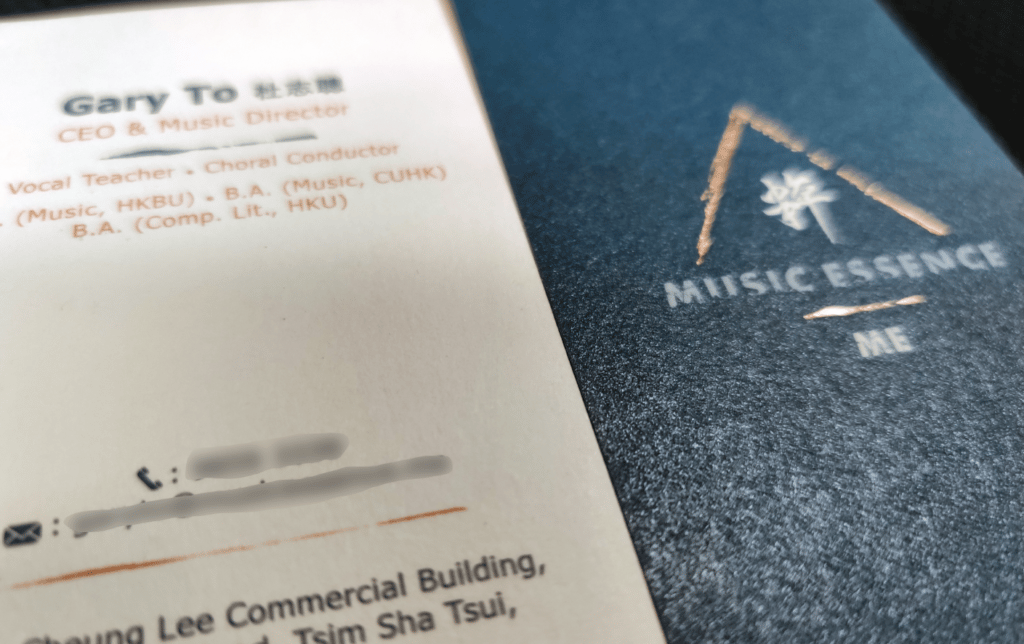
In the photo you can clearly see how the solid colour has masked the paper's natural grain — precisely because the ink is so heavy that the paper loses its own character.
Digital printing (數碼印刷)
The common way to print specialty paper is digital printing: it is fast and can be turned around in a short time, but it is not especially flattering for large colour blocks — dark ones in particular. Digital is a single pass with no second hit to build the colour up, so on deeply textured stock it readily prints unevenly. And because dark ink is laid down so heavily, the paper cannot always absorb all of it, so when the sheets are trimmed the edges shed colour easily.
For exactly this reason, some printers will not accept artwork with solid colour blocks.
Digital printing of large, dark designs also tends to leave the solid area looking glossy and reflective — that shiny, plasticky sheen (see below). Lighter colours print far more happily than dark ones.

* Shown above: a Sensation (超感紙) stock printed digitally — even its surface grain barely shows.
Printing a large colour area on specialty paper with a digital press — things to watch:
- Avoid large blocks of dark colour in the design
- Keep the total colour value within 15–250
- Avoid stocks with very deep texture
- Check with the printer before you go to print
- Be prepared to accept digital ink's reflective sheen
- A large colour area will cover up the paper's own texture
Can a coloured specialty paper print solid colour?
Some specialty papers come pre-coloured, and these need care whether you are printing solid colour or anything else, because the ink is influenced by the paper's own colour. Printing directly on black card, for instance, is close to impossible: lay bright yellow straight onto black card and it simply will not read as yellow — the black stock drags it into a muddy ochre. The lighter the stock's colour, the less it pulls your ink around.
Specialty paper has to be matched to the right method
Specialty paper is more complicated to print than everyday stock, and it needs the right printing method to go with it. If you want to save money with cheaper digital printing, take extra care — not every colour or paper texture will cooperate.
If you are after the best possible result, we would recommend a spot-colour run. Not sure which method your chosen stock needs? Message us on WhatsApp at +852 3001 5678 (English is fine) and we will talk it through before you commit to a print run — with delivery across Hong Kong and Macau.