A new year means new office stock, and for most companies that means reordering envelopes, letterhead and folders. By most informal counts, company envelopes sit comfortably in the top five print items a business gets through — so they are worth spec'ing properly. This guide walks through envelope and letter sizes, construction and price, so you can work out which option actually suits your office.
Company envelope sizes
Whatever you're printing, size is the first thing to settle. Our standard company envelope is a fixed 100 × 228mm, which takes an A4 sheet folded in half and then in half again. That's roughly a third of an A4 in size, and it holds five to six A4 sheets without any trouble.
The other popular option is 308 × 228mm (C4), which swallows a full, unfolded A4 sheet. You'll see this one more often for official correspondence, since it fits more paper.
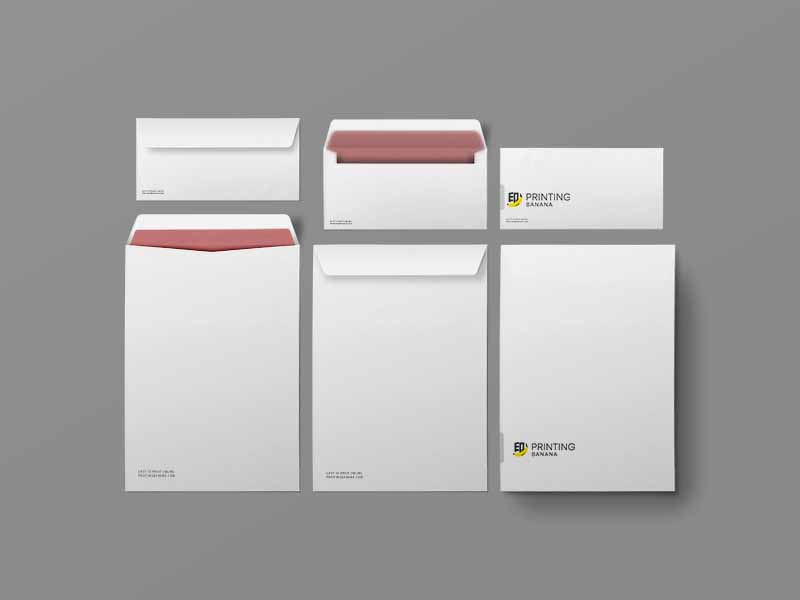
How company envelopes open
The 100 × 228mm envelope opens in one of three ways: the banker envelope (企口信封), the wallet envelope (荷包信封) and the diamond-flap envelope (鑽石信封).
The biggest difference between the three is the fold. The diamond flap is the everyday standard across Western countries, while the banker and wallet styles are more common in mainland China — which is why the trade labels them Chinese-style and Western-style envelopes respectively.
With or without a window
A window envelope has a rectangular panel die-cut into the front and backed with a thin sheet of clear film. Its job is to reveal the recipient's name and address as printed on the letter inside, so you skip the step of writing or printing the delivery details on the envelope itself. A non-windowed envelope has no cut-out, so nothing inside shows through.

Comparing company envelope prices
Finally, price. As you'd expect, the larger the size and the higher the quantity, the more it costs. Among the opening styles, the diamond flap is the dearest and the banker envelope the cheapest — the banker has the smallest unfolded footprint and uses the least paper, so it works out the most economical.
At 1,000 pieces, the per-envelope price difference between the three styles sits within about HKD 0.05 — small enough that you can simply pick whichever your company (or the boss) prefers.
Printed versus plain white
Take 1,000 envelopes and compare printed against unprinted (plain white). A plain white envelope averages somewhere around HKD 0.25–0.35 each (based on figures found online — for reference only), while a printed company envelope lands around HKD 0.6, depending on how it opens.
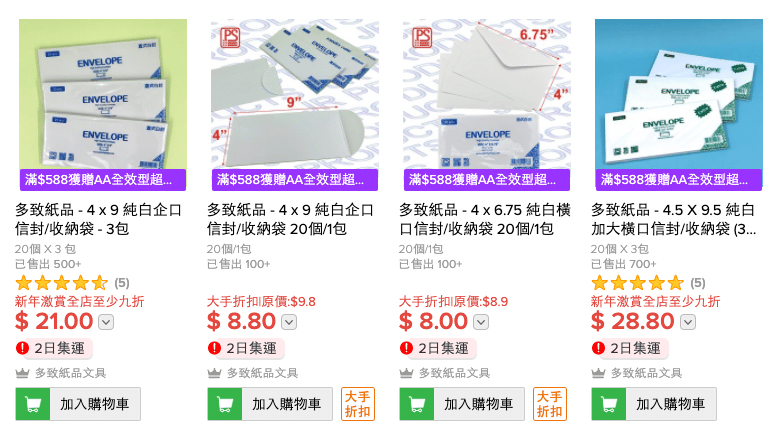
On the 1,000-piece number alone, a printed company envelope costs exactly double a plain white one — but it delivers far more than the difference suggests. A printed envelope signals the scale and standing of your business and shows you take your image seriously; as the saying goes, the clothes make the man.
Push the run up to 5,000 pieces, though, and the printed company envelope drops to roughly HKD 0.3 each, so the gap all but disappears. If your office gets through a lot of post, printing 5,000 or more is worth considering.
Size and quantity by need, opening style by preference
After all that, choosing a company envelope should be straightforward. Envelope printing starts at 1,000 pieces, and the more you use in a year, the better the unit price. The opening style is yours to pick by preference or need, since the three barely differ on price.
By now, most people lean toward printing their company envelopes rather than settling for plain white — chiefly because a printed envelope lifts your company's image, and image is built one small detail at a time, with a strong impression paying off over the long run.
Raise your company's image one envelope at a time. To start printing your own company envelopes — with delivery across Hong Kong and Macau — WhatsApp us at +852 3001 5678 (English is fine) and we'll help you spec the size, flap style and quantity.