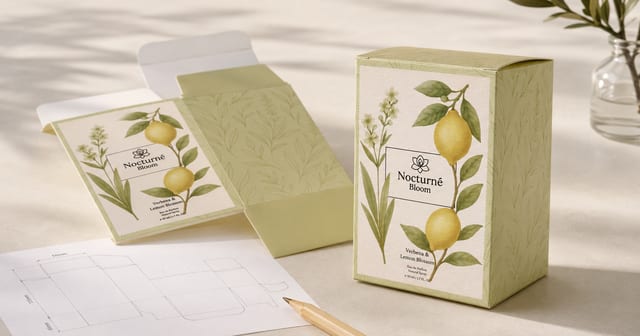
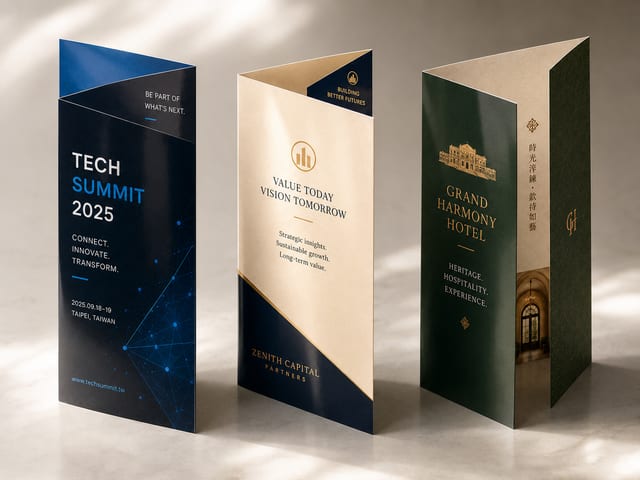
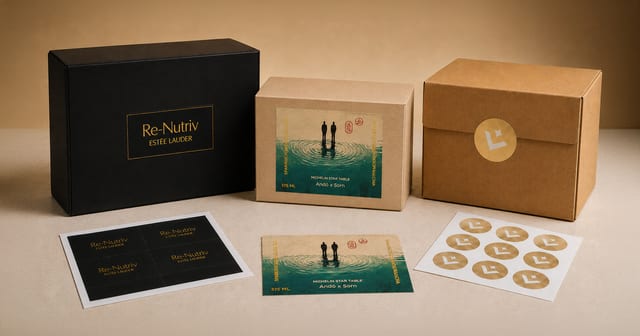
When you ask for a packaging quote, the first question isn't "how much for a box" — it's "what are the product's exact dimensions". Custom packaging covers gift boxes, paper bags, seal stickers, card sleeves, product labels and full gift sets, and the size, weight, quantity and assembly method all steer where the price lands.
Send a single product photo and a printer can only guess at a direction. Give the length, width and height, the weight of what goes inside, whether you need an inner tray and a rough quantity, and the conversation moves far faster — it's much easier to judge whether you should be making a box, a bag, stickers, or handling it first with simple packaging accessories.
Measure the product itself, not the box in your head
A lot of packaging enquiries open with "I want a premium gift box — roughly how much?" But with no product dimensions, it's hard to judge the box style, the board stock, the load it has to carry, or whether an inner tray is needed.
The more practical approach is to measure the product itself first:
Length: the longest side of the product.
Width: the widest side of the product.
Height: the tallest point once the product sits in the box.
Weight: an approximate figure, especially for glass, bottled, metal or multi-piece sets.
If the product isn't a neat rectangle — a bottle, a reed diffuser, jewellery, a food tin or an irregular gift — measure the most protruding point, not just the narrowest part in the middle.
Inner size, outer size, die-line size — what's the difference?
The most confusing thing about packaging dimensions is that the single word "size" can actually mean three different things.
Dimension | What it means | Why it matters for your enquiry |
|---|---|---|
Inner size | The usable space inside the packaging | Decides whether the product fits, and whether you need clearance or an inner tray |
Outer size | The finished dimensions measured on the outside | Affects storage, display, paper-bag pairing and shipping space |
Die-line size | The flat production size once the box or packaging is unfolded | Used for design, fold lines, glue tabs and production assessment |
For a first enquiry you don't need to work out the die-line yourself, but you do need to supply the product dimensions and the intended use of the packaging. The inner size, outer size and die-line are worked out from there.
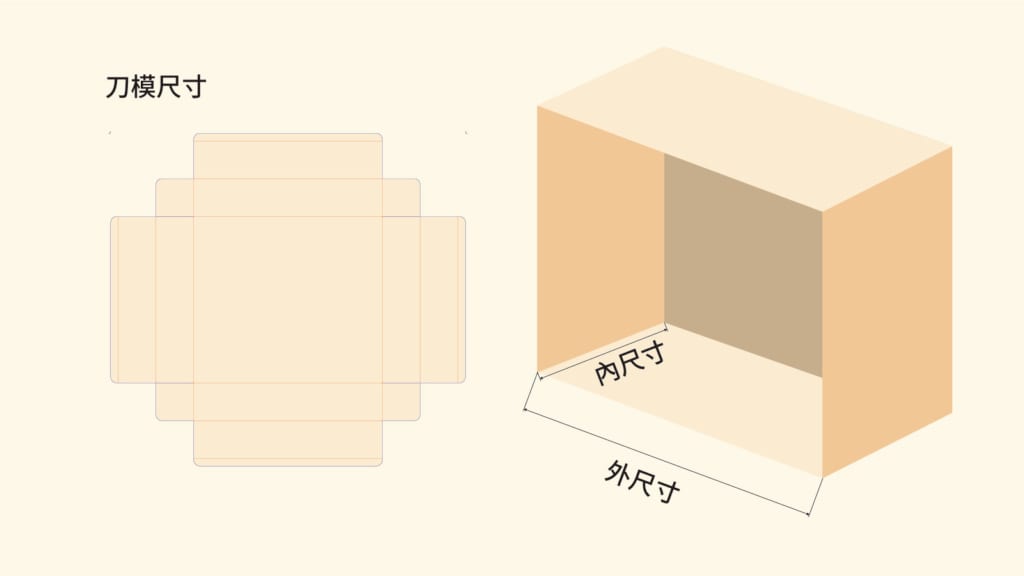
When you're quoting packaging, inner size, outer size and die-line size are not the same thing. Sort out these three concepts first and every later conversation about box style and dimensions gets much easier.
Do you need clearance? Start with whether the product moves
Pack it too tight and the product is hard to get in; pack it too loose and it looks cheap on opening and rattles in transit. Whether to leave clearance comes down to whether the product is fragile, whether it can get scratched, and whether it needs an inner tray or cushioning.
A few common cases:
Paper goods, fabric items, light small objects: usually don't need much clearance, but should be easy to slot in and pull out.
Glass bottles, ceramics, reed diffusers, skincare: factor in an inner tray, paper tray or cushioning.
Multi-piece sets: decide each product's position first — don't leave the layout until after the design is done.
Anything shipped: consider whether the packaging holds the product in place, not just whether it looks good.
If you're unsure, photograph the product, then mock up the fit with paper, card or a simple box to see whether it rattles too much.
For a gift set, lay it out once first
The classic gift-set problem is having each product's individual dimensions but never having laid the pieces out together. The outer box looks big enough, then in practice one item turns out too tall or too wide, or there's nowhere to put the small cards and stickers.
Before you enquire, do a quick layout:
Set every product on a table and arrange the unboxing order you want.
Decide which piece is the hero and which are supporting items.
Leave room for instruction cards, thank-you cards, seal stickers or a booklet.
Take a top-down photo to make the packaging direction easy to communicate.
It's a simple step, but it saves you from reworking the box style and dimensions over and over later.
The 5 things to send when you ask for a quote
If you want a genuinely useful packaging direction back, send all of the following in one go.
Detail | Example |
|---|---|
Product dimensions | Length, width, height — ideally in mm or cm |
Product weight | An approximate figure, especially for glass, metal or multi-piece sets |
Packaging use | Online-store shipping, in-store sales, corporate gifting, event giveaways |
Items needed | Boxes, paper bags, seal stickers, card sleeves, thank-you cards, labels |
Estimated quantity | How many units, how many sets, and whether there are several variants |
If you already have a logo, artwork, brand colours, product photos or a reference package, include those too. None of it means an instant price, but it makes the initial assessment far more accurate.
The 4 most common packaging-enquiry mistakes
Packaging quotes usually stall not because the idea is complicated, but because a few basics are missing. These four mistakes are the most common — head them off before you enquire.
Sending only a product photo, with no length, width or height.
Measuring only the front of the product and forgetting the height or the most protruding point.
Not laying out a gift set, so you don't know whether the pieces sit together sensibly.
Forgetting to leave room for an inner tray, instruction card, seal sticker, thank-you card or other accessories.
If you're not sure your measurements are accurate, the simplest fix is to photograph the product next to a ruler and add the dimensions by hand. That's far easier to work from than a plain product shot.
FAQ
I don't have a die-line yet — can I still ask for a packaging quote?
Yes. For a first enquiry, the important thing is to supply the product dimensions, weight, use and quantity. The die-line can be handled later, once the packaging direction is set.
I only have a product photo, no dimensions — can you estimate a price?
A photo alone usually only points to a direction; it can't pin down packaging size or cost accurately. Measure the length, width and height first, then add the product's weight and use.
Is the inner size the same as the product size?
Not necessarily. The inner size usually has to allow for whether the product goes in easily and whether it needs cushioning, an inner tray or protective space. Too snug isn't always practical; too loose can hurt both the look and how securely the product is held.
For a gift set, do I decide the box first or what goes inside first?
Decide what goes inside first, then the box. The number of products, their sizes, heights and arrangement all directly drive the packaging's dimensions and structure.
Ready to enquire about custom packaging?
Before you get in touch, measure the product's length, width and height, and pull together your product photos, weight, intended use, the packaging items you need and an estimated quantity. With those in hand, the next step — deciding whether you need boxes, paper bags, seal stickers, card sleeves or a full gift-set package — can be judged far more accurately.
Not sure which way to go? WhatsApp Printing Banana at +852 3001 5678 (English is fine) — send your product photos, dimensions and estimated quantity and we'll help you settle the packaging direction. We deliver across Hong Kong and Macau.